Die Ein-Satz-Zusammenfassung
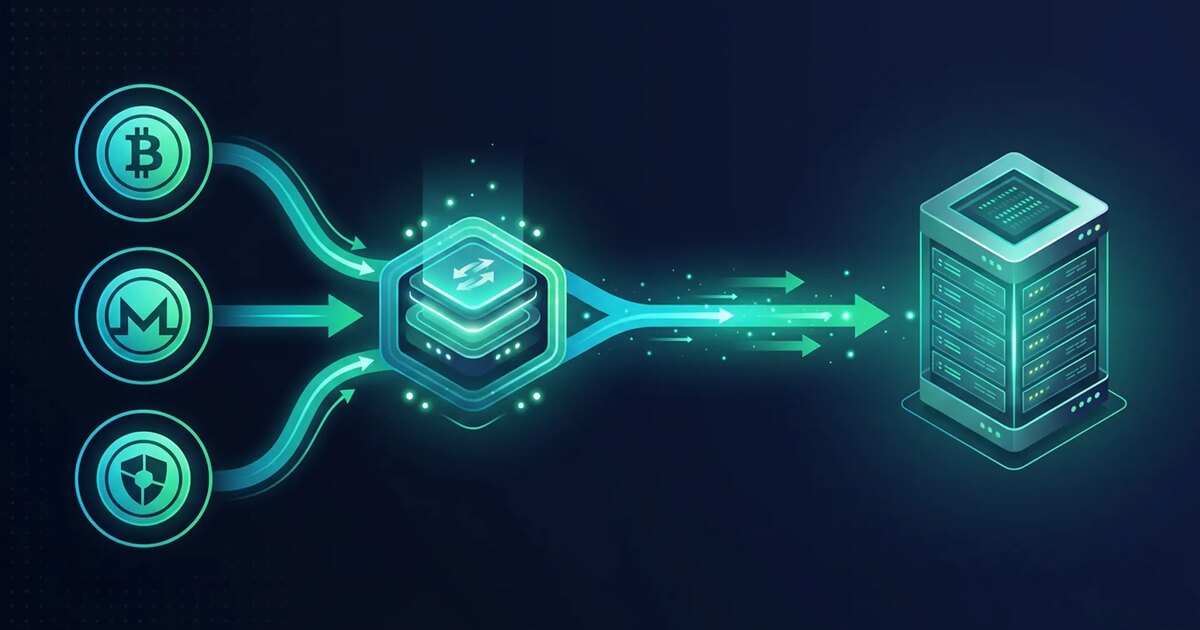
If you want maximum on-chain anonymity, pay in Monero. If you want minimum fees and an existing wallet you already trust, pay in Bitcoin via Lightning. If you want neither maximised — you just want to pay quickly and move on — Litecoin or Bitcoin Cash settle faster than legacy Bitcoin and cost less. Every other consideration (price stability, exchange-rate risk, regulatory exposure) is downstream of those three.
Abwicklungszeit bei der Übertragung
Bitcoin (mainnet, on-chain): one confirmation in the median ~10 minutes, with substantial variance. We credit the order at first confirmation, which means your server provisions in roughly 8–12 minutes from the moment your wallet broadcasts. The downside is that during fee-spike periods (mempool congestion above ~30 sat/vB), getting included in the next block requires a competitive fee — typically $0.50–$3 in normal periods, $5–$25 during spikes. Bitcoin Optech's fee primer is the best technical reference on how fee estimation actually works.
Bitcoin via Lightning: settles in seconds. We support Lightning invoices at /pay/ — the deposit address is replaced by a Lightning bolt11 string. If you have a routing-capable Lightning node (LND, Core Lightning, Eclair), the payment finalises before you can switch tabs. Fees are routing fees only — typically pennies. The catch is that the customer needs Lightning capacity in the right direction; for small-balance wallets this isn't always available.
Monero: one confirmation in ~2 minutes, ten confirmations in ~20 minutes. We credit the order at first confirmation. Monero blocks are produced every two minutes (vs Bitcoin's ten), so settlement is fundamentally faster. Fees are dynamic but always low — typically $0.01–$0.05 regardless of network conditions.
Litecoin: one confirmation in ~2.5 minutes, fees ~$0.01–$0.05. Same settlement speed as Monero with Bitcoin's transparent ledger. Underrated for routine payments where neither extreme matters.
Bitcoin Cash: one confirmation in ~10 minutes (same as BTC) but with cheap fees because the larger block size keeps the mempool clear — typically pennies.
Ethereum: one confirmation in ~12 seconds. Fees vary wildly with gas price; $0.20 on a quiet day, $20+ during NFT mania. We credit at one confirmation.
On-Chain-Nachverfolgbarkeit — was jede Chain preisgibt
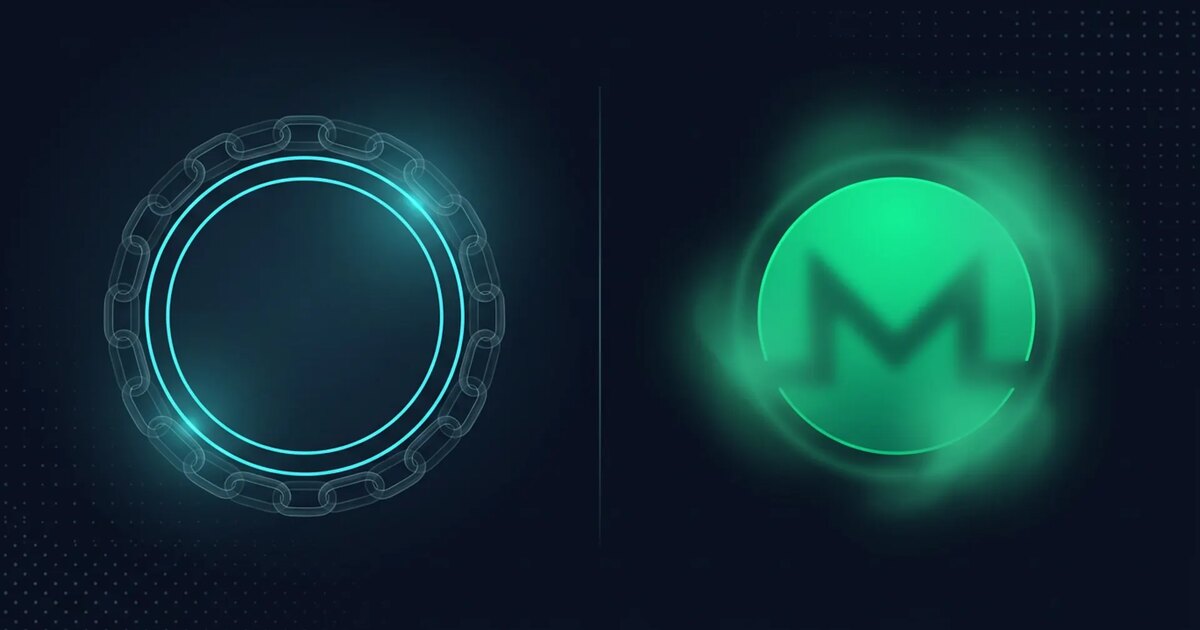
Bitcoin: every transaction is public. The fact that wallet X paid wallet Y the amount Z at time T is permanently visible to anyone with a block explorer. Chain analysis firms like Chainalysis and Elliptic specialise in clustering wallets to real identities through behavioural fingerprints, exchange-deposit traces, and address-reuse patterns. The Bitcoin Wiki's privacy primer is a thorough catalogue of every linkage vector. Even with CoinJoin (Wasabi, Whirlpool, JoinMarket) the entropy added is finite; sustained linkage analysis can sometimes still triangulate.
Monero: transactions use ring signatures, stealth addresses and confidential transactions to obscure sender, receiver and amount on-chain. A block explorer shows a Monero transaction occurred at time T but cannot reveal which inputs funded it, which outputs received it, or how much was sent. The Monero project's technical overview walks through the cryptographic primitives in detail. Monero is the only mainstream cryptocurrency where this anonymity is on-by-default rather than an opt-in privacy layer; the network as a whole is uniformly private.
Litecoin and Bitcoin Cash: same transparent-ledger model as Bitcoin. MimbleWimble extension blocks (MWEB) are available on Litecoin and offer some confidentiality, but adoption is low and most wallets don't use them.
Ethereum: fully transparent ledger with even more contextual data than Bitcoin (smart-contract calls, internal transactions, ERC-20 transfers all visible). For privacy on Ethereum, Tornado Cash was the historical answer until US OFAC sanctioned it in 2022; today there is no widely-used privacy tool on Ethereum mainnet that doesn't carry sanctions risk.
Den Coin ohne KYC erwerben
If you don't already own the coin, you have to acquire it — and the acquisition route can leak more identity than the payment itself. Buying Bitcoin on Coinbase or Kraken is fully KYC'd; the on-chain trail from that purchase to your server payment is permanently linkable.
Monero acquisition options: LocalMonero (deprecated 2025; check successor sites), Bisq DEX, atomic-swap from Bitcoin via COMIT or Farcaster protocols, mining (slow but realistic on a CPU), peer-to-peer cash trades on /r/MoneroOffers and similar. The shortest non-KYC path is BTC→XMR atomic swap if you already hold BTC; if you don't, Bisq with a SEPA cash deposit is the most accessible.
Bitcoin acquisition options without KYC: Bisq, Robosats, Hodl Hodl, Peach (mobile), and the various Lightning-native non-KYC exchanges (LN Markets, Boltz). Lightning swaps are particularly clean because the on-chain trail terminates at the swap operator, not at you.
Pre-existing wallet: if you already hold BTC or XMR from a prior non-KYC source (mining, gift, peer-to-peer, an old wallet), use that — the cleanest path is the one that doesn't require you to acquire anything new.
Volatilität und Wechselkursrisiko
Hosting bills are quoted in USD and converted to crypto at order time. The conversion rate is locked for 60 minutes. If you pay within the window, you pay exactly the amount quoted. If you pay outside the window, the order re-prices at the then-current spot rate.
Bitcoin and Monero have similar 30-day volatility (typically 3–6% standard deviation). Stablecoins (USDT, USDC) have ~0% volatility but require an Ethereum/Tron/Solana wallet and gas fees, and they re-introduce KYC at the issuer level (Tether and Circle both freeze blacklisted addresses).
If you're prepaying for a year and want predictable cost, a stablecoin is the right pick. If you're paying month-to-month and timing the market matters less, Bitcoin or Monero is the cleanest crypto-native path.
Regulatorisches Risiko (Ihres, nicht unseres)
We don't care which coin you pay with — they all settle to USD on our books and the legal posture is the same. But your jurisdiction may treat these differently. In the US, Monero acquisition through some venues is now restricted by FinCEN guidance; in the EU, MiCA Article 76 requires CASPs to disclose privacy-coin transactions. None of this prevents you from paying us, but it may shape which coin is most operationally clean for you to acquire.
If you're already past the acquisition step (the coin is in your wallet from any source), the regulatory question is mostly behind you — the on-chain payment to our address is just a transfer. The compliance pressure is at the on-ramp/off-ramp, not the wallet-to-wallet hop.
Praktische Empfehlungen nach Anwendungsfall
I'm new to crypto, I just want to pay quickly: Litecoin. Cheap, fast, settles in 2–3 minutes, and on-ramps are widely available without much friction. Anonymity is comparable to Bitcoin (transparent ledger), but you avoid Bitcoin's fee unpredictability.
I'm running a Tor exit relay, journalism workflow, or anything where on-chain unlinkability matters: Monero. The default anonymity model is what you want, and the fee structure is predictable enough for monthly billing.
I already have a Lightning wallet and want minimum cost: Bitcoin via Lightning. The /pay/ page generates a bolt11 invoice; pay it and the order provisions in seconds for fractions of a cent.
I'm prepaying a year and want price stability: USDT or USDC on Tron (cheapest gas) or Ethereum. Accept the trade-off that the issuer can freeze the wallet (extremely rare for non-blacklisted addresses, but technically possible).
I have a small amount of an exotic coin from an airdrop and want to use it up: Dash, BCH, DOGE all settle quickly with low fees. We accept all three; pick whichever you have.
Was wir hinter den Kulissen tun
Each invoice generates a unique deposit address — never reused. We watch the address for incoming transactions, credit the order at first confirmation (one for Monero, Litecoin, BCH, Dash, Doge; one for BTC; one for ETH), and immediately move the deposit to our cold operational wallet via a fresh outbound transaction. We don't custody customer funds beyond the time it takes the orchestrator to provision the server.
We don't run our own exchange operation. Funds that need to be converted to USD for accounting purposes are swapped through standard non-custodial routes (atomic swaps, Bisq, instant-swap providers) and never tied to a single customer's payment. The on-chain link from your payment to our cold wallet is one hop; from there it's a separate operational concern.
We do not do chain analysis on inbound payments. We do not maintain a blacklist of "tainted" addresses. We do not refuse payments from CoinJoin'd UTXOs, mixer-output UTXOs, or any other source. The only question we ask of an inbound payment is whether it confirmed; if it did, the order is paid.