Pourquoi Monero — une introduction de cinq minutes
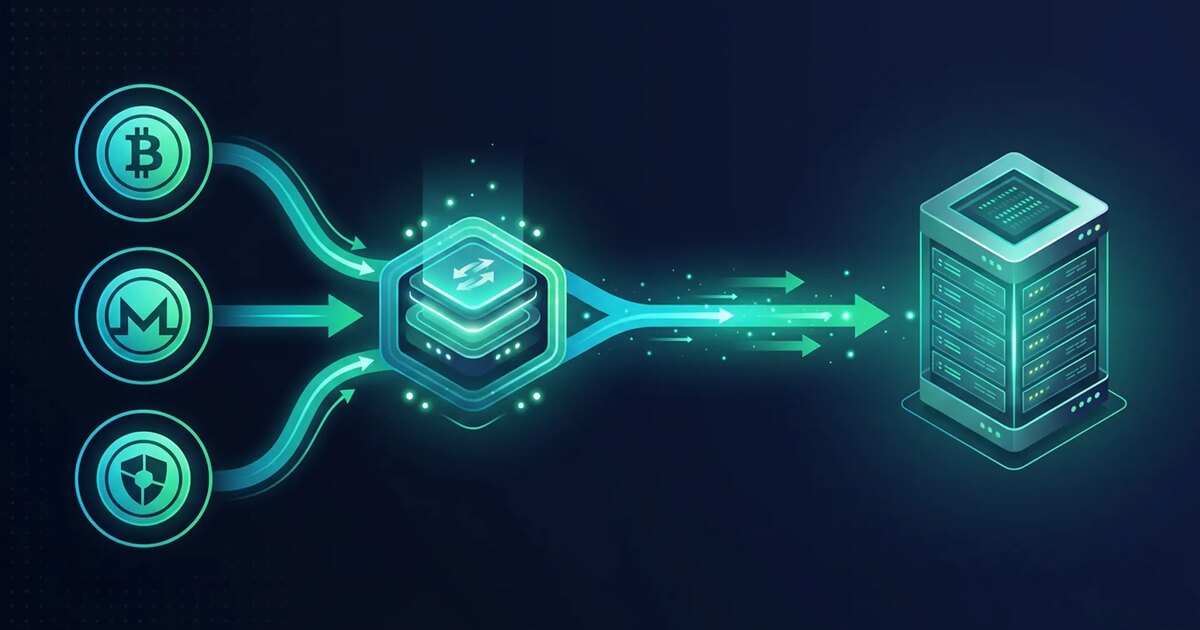
Monero (XMR) is a cryptocurrency that uses cryptographic primitives to obscure sender, receiver and amount on every transaction. Unlike Bitcoin, where every transaction is public and forensically traceable, Monero transactions reveal only that something happened at time T — not who sent, who received, or how much. The Monero project's technical overview walks the cryptographic primitives in detail; the short version is three layered techniques.
Ring signatures: when you sign a transaction, your signature is mixed with several decoy signatures from past blocks. An observer cannot tell which signature is yours. The ring size is currently 16 (you + 15 decoys), making the disambiguation problem cryptographically hard.
Stealth addresses: each transaction generates a new one-time output address derived from the recipient's public key. Even if you watch the recipient's published address forever, you'll never see a transaction to it directly — every transaction goes to a unique stealth address generated for that specific transaction.
RingCT (confidential transactions): transaction amounts are encrypted using Pedersen commitments. The network can verify that the input sum equals the output sum (no inflation) without anyone seeing the actual amounts. This was activated on the Monero network in 2017 and is mandatory for all transactions since.
The combined effect is that Monero is the only major cryptocurrency where blockchain analysis is not a meaningful threat. Bitcoin's privacy depends on careful operational hygiene (CoinJoin, fresh addresses, payjoin); Monero's privacy is on by default for every transaction.
Choix de portefeuilles pour 2026
Cake Wallet — mobile-first, iOS + Android + macOS. The most user-friendly Monero wallet by a wide margin. Includes built-in exchange functionality (BTC ↔ XMR atomic swaps, plus integration with several exchange APIs), good UX, regular security audits. Recommended for users coming from Bitcoin wallets like BlueWallet or Phoenix.
Feather Wallet — desktop-only, Linux + Windows + macOS. Lightweight, open-source, no built-in exchange. The standard pick for desktop users who want a focused Monero-only client. Compatible with Trezor and Ledger hardware wallets.
Monerujo — Android-only, very mature. Built-in Tor support for connecting to remote nodes through Tor. Used by many privacy-focused users in regions where mobile is the primary computing platform.
Monero GUI / CLI — the official wallets from the Monero project itself. Most feature-complete, most secure (most audited), most demanding in terms of disk space (full chain sync requires ~150 GB in 2026 and growing). The standard pick for users running their own node.
Hardware wallet integration: Ledger and Trezor both support Monero through Cake Wallet, Feather, and Monero GUI. Hardware-wallet signing is recommended for any wallet holding more than a few hundred dollars equivalent.
All five options are available at the project's official pages or through their respective platform stores. The getmonero.org user guides walk through wallet setup for each option.
Frais et délais de confirmation en pratique
Monero block time is approximately two minutes — significantly faster than Bitcoin's ten minutes and broadly comparable to Litecoin's 2.5 minutes. Each new block confirms one set of transactions, and a transaction's number of confirmations grows with each subsequent block.
We credit Monero payments at one confirmation for orders under $50 and at ten confirmations for orders above $50. The threshold reflects the practical risk of a chain reorganisation: a 1-block reorg on Monero is not common but happens occasionally; a 10-block reorg is essentially never observed in normal operation. The Monero project's developer guides document the chain mechanics in detail; for testing without spending real XMR, the project also maintains a public stagenet with the same protocol behaviour.
Median time to one confirmation: approximately 2 minutes from the moment your wallet broadcasts. Median time to ten confirmations: approximately 20 minutes. Worst case during network congestion: rare, but a single block can take 4–6 minutes if hash rate temporarily drops; ten confirmations can take 40 minutes in such cases.
Fees: dynamic, based on a Monero-specific fee algorithm that adjusts to network demand. In typical conditions: $0.01–$0.05 per transaction at default priority, $0.05–$0.20 at "fast" priority, $0.005–$0.02 at "slow" priority. These numbers are stable across network conditions because Monero's variable block size absorbs demand without dramatic fee escalation.
Remboursements en Monero
Refunds in Monero are technically straightforward but operationally distinct from refunds in Bitcoin. Because each Monero transaction goes to a unique stealth address derived from the recipient's keys, we cannot refund to the same address you paid from — the address is not reusable, and we cannot derive the next stealth address without knowledge of your private spend key (which we do not have).
The standard refund flow: you provide a fresh receiving address (from your wallet's "Receive" tab); we send the refund to that address from our cold operational wallet. The refund is a normal Monero transaction with the same privacy properties as your original payment.
Time to refund: typically initiated within 24 hours of the refund request, with the actual on-chain transaction occurring during our daily treasury operations window. Once broadcast, the customer sees the funds in their wallet within two minutes (one confirmation) or twenty minutes (ten confirmations) depending on what their wallet treats as "received."
Pièges courants et comment les éviter
Sending the wrong amount. The /pay/ page shows the exact XMR amount to send. Sending more does not get you more service — it credits to your account balance for future use. Sending less means the order stays in "awaiting" until you top up the difference. Always double-check the amount in your wallet before confirming.
Sending to the wrong address. Monero deposit addresses are long (95 characters) and look similar to each other — XMR addresses all start with "4" or "8". Use the QR code from the /pay/ page rather than typing the address manually; QR scanning eliminates transcription errors.
Wallet not synced. New wallet installations and wallets that haven't been opened recently need to sync against the Monero blockchain before they can send. Cake Wallet and Feather sync against remote nodes automatically (a few minutes); Monero CLI/GUI without a local node also syncs against remotes. A wallet that hasn't synced since you last used it can take 5–30 minutes before it can send.
Subaddress confusion. Monero supports subaddresses (multiple receiving addresses derived from a single wallet). The deposit address we provide is a primary or subaddress on our wallet; you don't need to worry about which — just send to the address shown. On your wallet, when you receive a refund, it will arrive at whichever address you specified.
Paying past the rate window. The /pay/ page locks the USD-to-XMR rate for 60 minutes. If you pay outside the window, the order re-prices at the current spot rate and you may need to top up a small delta (or you may have surplus credit, depending on which way the market moved). The order does not fail; it just re-quotes.
Using a custodial exchange wallet to pay. Some exchanges (Kraken, KuCoin) will let you withdraw XMR directly. Some (most US exchanges as of 2026) have delisted XMR. If you're paying from an exchange withdrawal, the exchange treats it as a normal on-chain send; the privacy is whatever the exchange's withdrawal flow provides. For maximum privacy, withdraw to your own wallet first and pay from there.
Considérations de confidentialité spécifiques au paiement XMR
Acquiring Monero in the first place is the trickiest privacy step. Mainstream KYC'd exchanges that still list XMR (Kraken, some others) link your wallet to your verified identity; the on-chain trail from withdrawal is technically private, but the exchange's records are not. For full unlinkability, acquire Monero through non-KYC routes: peer-to-peer cash trades on the various Monero-specific community boards, Bisq DEX, BTC ↔ XMR atomic swaps, mining (Monero is RandomX-based and remains CPU-mineable in 2026), or trades in your local community.
Once you hold Monero, paying us is simple. The on-chain hop from your wallet to our deposit address is private at the protocol level; even an adversary with full chain visibility cannot link your wallet to our address. We don't keep the deposit address linked to your account in any persistent way once the order is paid.
Tor for the wallet network connection. Most Monero wallets support routing their network connections through Tor for additional privacy. Cake Wallet, Feather, Monerujo and Monero CLI/GUI all have Tor options. This protects against IP-level metadata leaks during wallet operations; the on-chain transactions themselves are already private.
Comparison context: paying in Bitcoin at the same threat level requires substantially more operational hygiene (CoinJoin from a clean UTXO set, fresh addresses, payjoin where possible). The Bitcoin Wiki's privacy primer documents what's required. Monero's default-private model eliminates almost all of this complexity — for routine recurring payments, it's the right tool by a wide margin.